

Node 009 | The Frankist Counter-Current and Sacred Transgression
Entry from 'The Impression and the Seal: A Comprehensive Inquiry into the Suppression, Transmission, and Weaponization of Ancient Knowledge Across Civilizations, Empires, and Esoteric Traditions'

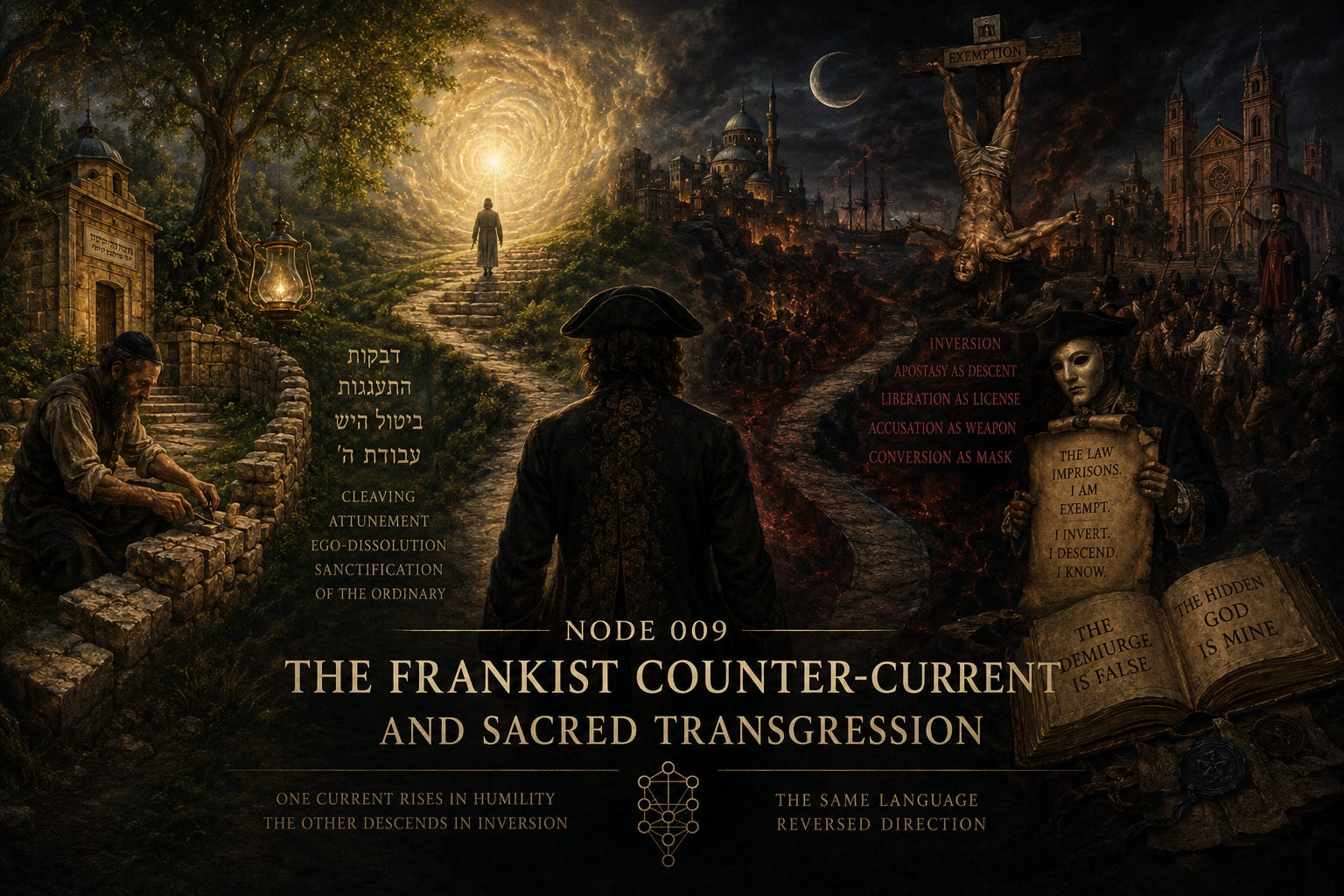
Jacob Frank was born in 1726 in Korolivka, Podolia, the same broad geographic matrix that produced the Baal Shem Tov in the same generation. This proximity matters. The region was not merely background. Podolia, Galicia, Bukovina, and the Carpathian borderlands formed a charged transmission zone: Jewish mystical expectation, imperial instability, Sabbatean residue, Hasidic emergence, Ottoman contact, Polish Catholic pressure, and folk-religious density overlapping in the same territory.
From this same field, two opposite currents emerged.
Node 007 established the direct-access signal: within the deepest layer of consciousness exists an immediate point of contact with ultimate reality, prior to institutional mediation. The traditions that carry this signal share a structural orientation. The self is not inflated by contact with the Source. It is ordered by it. Ego dissolves before divine presence. Interior coherence is achieved through discipline, through cleaving, through attuned making, through the long refinement of attention.
Node 008 extended that observation into matter: the interior condition of the maker transmits into the made object. Attunement passes through the hand. The Sar Shalom built stone by stone. The frequency of the builder entered the building. The structural claim across both nodes is consistent: genuine transmission moves through disciplined self-subordination, not through self-authorization.
Node 009 introduces the counter-current.
Frank’s father was a Sabbatean. Frank grew up in the Carpathian region of Bukovina, where Sabbatean influence remained active beneath the surface after the collapse of Sabbatai Zevi’s messianic movement. As a merchant in Ottoman territories, Frank spent extended periods in Salonica and Smyrna, the primary centers of the Donmeh, the crypto-Jewish Sabbatean community formed after Sabbatai Zevi’s conversion to Islam.
Sabbatai Zevi had been born in Smyrna in 1626. In 1665 and 1666, he declared himself Messiah, and the effect spread across the Jewish diaspora with extraordinary force. Communities from Amsterdam to Morocco to Constantinople prepared for imminent redemption. Some sold possessions. Some altered liturgical expectation. A messianic pressure wave moved across the scattered body of Israel.
Then came rupture. Summoned before the Ottoman Sultan in 1666, Sabbatai Zevi converted to Islam to avoid execution. The act should have destroyed the movement cleanly. Instead, for many of his followers, it became the key to a new theology. The Messiah had not failed. He had descended. He had entered apostasy as a sacred operation. He had become the opposite of himself in order to complete the work from below.
Failure became revelation.
Apostasy became method.
The collapse of a messianic movement did not end the movement. It inverted it. What should have disconfirmed the claim became the deepest proof of the claim. The wound did not heal. It theologized itself.
The Donmeh carried this inversion forward in Salonica. Publicly Muslim, privately Sabbatean, they lived inside a double structure: outward conformity, inward continuation. The ordinary categories could no longer contain them. Jew and Muslim, apostate and faithful, concealment and revelation, fall and mission were deliberately entangled. A community formed around the idea that contradiction itself might be the path.
Jacob Frank received this transmission and radicalized it.
By 1755, Frank was teaching in Podolia. His doctrine moved through Gnostic vocabulary but carried a distinctly Sabbatean wound. The God of conventional religion was not the true God. The creator described by ordinary religious authority was a false imprisoning power, a Demiurge. Beyond this structure stood a hidden God, the true Source, inaccessible through the laws and institutions that claimed to mediate divine order.
The law, in Frank’s teaching, did not liberate. It imprisoned.
Frankism was not a continuation of the transmission. It was inversion. Devekut, the Funklein, and sacred attunement move through discipline, humility, interior coherence, and the dissolution of ego before the Source.
Frankism takes one genuine insight, that institutional law can become prison, and converts it into permission. The movement does not dissolve the self before the hidden God. It inflates the self by claiming exemption from ordinary moral consequence. The language of liberation remains. The direction reverses.
Not every use of sacred vocabulary points toward the sacred function. A movement can speak fluently of hidden divinity, direct access, and liberation from false mediation while producing the opposite orientation in its practitioners. The test is not the vocabulary. The test is what the vocabulary produces in the person who receives it.
This is why Frankism matters in the sequence. It is not simply a scandalous sect, an antinomian outbreak, or a failed messianic aftershock. It is a counter-current wearing the vocabulary of liberation while reversing liberation’s direction. The sacred is invoked to sanctify transgression. The hidden God is invoked to escape the visible demand of moral relation. The critique of false mediation becomes permission to harm what mediation had imperfectly protected.
Frank’s conflict with the Jewish community intensified rapidly. In 1759, he arranged a theological disputation before Catholic authorities in Lwów. There he deployed the blood libel against the Talmud, turning one of the most lethal accusations in European history against the community from which he had emerged. The operation was precise and devastating. Frank did not merely leave the community. He offered its enemies theological ammunition.
Frank and his followers subsequently converted to Catholicism. This was not simple assimilation. It was a second inversion. Like Sabbatai Zevi’s conversion to Islam, Frank’s conversion did not function for his followers as abandonment of the hidden mission. It functioned as descent into the external structure. Catholic nobility, Polish authority, and anti-Talmudic polemic became the new covering through which the counter-current moved.
The Baal Shem Tov’s reported response to Frank’s conversion was severe: the amputation of a diseased limb. Once amputated, it was gone, and there was no hope.
The statement is important because it does not treat Frankism as mere error. It treats it as pathology within a body. Not an outside enemy. Not a rival religion. Not a misunderstanding that could be corrected through debate. A diseased limb.
The metaphor carries surgical precision. A diseased limb remains part of the body until its continued attachment threatens the body’s survival. Amputation is not punishment. It is the moment when continuity itself becomes dangerous. The body preserves life by severing what still bears its name but no longer carries its health. This distinction will matter later.
Frankism did not disappear after Frank’s death in 1791. The organized movement weakened, but its structure did not simply evaporate. It had already entered Catholic aristocratic networks through conversion, patronage, and marriage. It had learned to operate through crypto-identity, double belonging, and inversion beneath public profession. The record becomes less clear after Frank, but the object does not close.
A movement founded on hidden continuity does not leave the same archival profile as a public institution.
What can be said with confidence is that Frankism introduced a specific doctrinal weapon into the European field: liberation through transgression, hidden divinity against visible law, sacred exception against inherited moral order, and the use of host institutions as masks for an interior counter-current.
Not all transgression is counterfeit liberation. Some laws are false. Some boundaries protect domination. Some institutions sacralize control and call it order. Every direct-access tradition examined so far understands this. The problem is not the recognition that law can become prison. The problem is what follows.
A genuine liberating current breaks false law in order to restore contact with reality. A mimic current breaks law in order to enthrone the breaker. That is the difference.
One produces humility before the Source. The other produces exemption in the name of the Source. One dissolves separation. The other weaponizes separation while claiming to have transcended it. One returns the person to moral relation at a deeper level than rule-following could reach. The other uses the language of depth to escape moral relation altogether.
The Frankist counter-current takes the genuine insight that mediation can become prison and turns that insight into a license for inversion. It takes the Gnostic critique of the Demiurge and converts it into a political instrument. It takes messianic failure and makes it proof. It takes apostasy and calls it descent. It takes accusation and turns it against the community that carried the tradition. It takes conversion and makes it a mask.
The result is not absence of religion. It is religion inverted into counter-transmission.
Frankism does not complete the argument. It opens it. The doctrinal weapon it introduces, liberation through transgression, hidden divinity against visible law, sacred exception against inherited moral order, and host institutions as masks for interior counter-currents, will reappear in different containers, different geographies, and different centuries. The specific comparison between Frankism and other internal destroyer movements that weaponize their host traditions while claiming to restore them belongs to a later development of this inquiry. Here it is sufficient to note the object’s first clear appearance in this sequence: a movement that understood enough of the direct-access signal to imitate it, and used that imitation to hollow out the transmission it claimed to carry.
The counter-current does not oppose the transmission by denying its vocabulary. It enters through the vocabulary. It preserves the words while reversing the direction.
An Unresolved Sequence Remains:
What distinguishes genuine liberation from the performance of liberation?
When does transgression expose a false law, and when does it become the ego’s claim to exemption?
Why did Frankism emerge from the same geographic and generational matrix as the Baal Shem Tov?
What does it mean when a counter-current uses the vocabulary of direct access while producing betrayal, domination, and harm?
How does a living tradition recognize a diseased limb before the disease presents itself as renewal?
What can be responsibly documented about Frankist continuity, and where does the archive dissolve into inference?
At what point does internal rebellion become a mimic signal wearing the language of the tradition it seeks to hollow out?